

Naming Ceremonies in West Africa
February 12, 2024
West African Adventure Checklist
February 15, 2024

West Africa holds within it a collection of cultural and heritage sites that reflects the diverse people, traditions and culture. We compiled a list of culture and heritage sites to consider on your trip to the sub-continent. Sites, some of which are UNESCO World Heritage sites, that tell incredible stories of the resilience and rich history of Africa.
Goree Island, Senegal

The Island of Gorée holds a deep and dark history as the largest slave-trading port in West Africa. Located of the coast of Senegal, Gorée island was ruled by the Dutch, Portuguese, French and English with about 28 slaves houses before the end of the transatlantic slave trade. The island still contains emotional remnants of the slave era like the Maison des Esclaves (House of Slaves), Fort d’Estrées and several governor houses among others. The island was officially added to UNESCO World Heritage site list in 1978.
Grand Bassam, Côte d’Ivoire

Grand Bassam, a town in Côte d’Ivoire with historic and political significance was the first capital of Côte d’Ivoire.This port city was the centre of economic and judicial power in the country. A tour of the city feels like a walk down the halls of the past as the town is still filled with well-preserved buildings that offer a glimpse into the past.
Cidade Velha, Ribeira Grande, Cabo Verde

Cidade Velha, in Cabo Verde, translated from Portuguese to English means old city which is a befitting name as the island is the oldest city on the island of Santiago and held political significance as the former capital of the country. Visit popular sites such as the Royal Church, Casa Amarela, Pelourinho, São Filipe Royal Fortress, etc. The city is an exciting addition for travellers who are connoisseurs of history.
Cape Coast Castle, Ghana

Cape Coast Castle, located in the former capital of Gold Coast – present day Ghana, is one of the most visited sites in the country and West Africa. The dungeons and hallways of Cape Coast castle serve as a poignant reminder of the struggles and plight of the enslaved Africans shipped never to return home.
Koutammakou, Togo

Koutammakou, Land of the Batammariba, is located in north eastern Togo. The village is rife with traditions and customs of traditional village life with the architectural style of their mud-houses, known as siken, garnering a place on UNESCO’s World Heritage Site list in 2004. The Tammari people who have resided in the area for centuries practise animism which is the belief that inanimate hold souls and supernatural powers.
The Sacred Groves of Osun-Osogbo, Nigeria

As legend has it, a great hunter led a community to the banks of the Osun river to avoid hunger and death. The groves are sacred and considered as a place of worship by the Yoruba across Nigeria, Benin, Togo, Brazil and the African diaspora with over 40 shrines dedicated to the goddess of fertility, Oshun. Yearly in August, practitioners of the religion converge to commune and pay their respects during the Osun festival. The sacred groves were added to the UNESCO world heritage site list in 2005.
Royal Palaces of Abomey, Benin

Made up of 12 palaces in Abomey, Benin (formerly known as Dahomey), the Royal Palaces were built by 12 kings who consecutively ruled the kingdom and sprawled over an impressive 47 hectares. Each palace housed the King and his entire court. The Palaces are a reminder of the once vast power and opulence of the Dahomey empire. After a tornado devastated the heritage site in 1984, the palaces were renovated with the support of several international agencies and recognised as a UNESCO World Heritage site in 2007.
Tomb of Askia, Mali
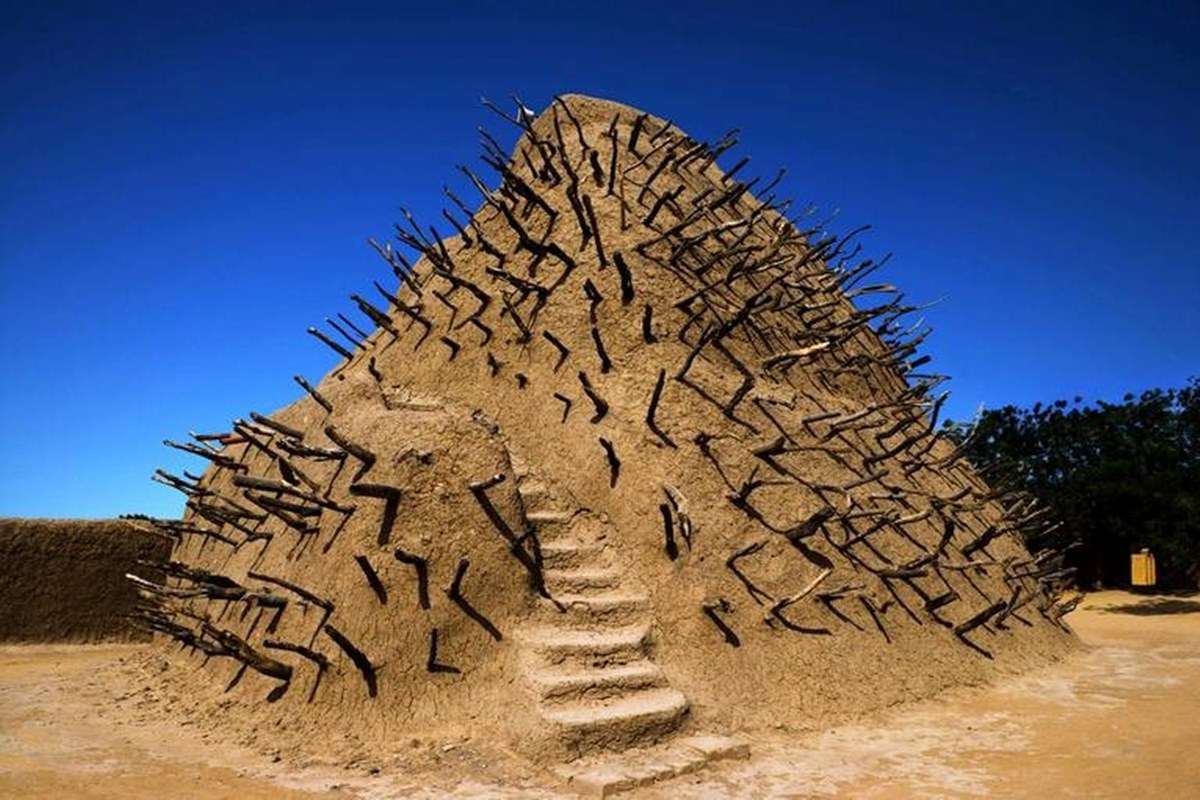
The tomb of Askia built by Mohammed I of the Songhai Empire. After a pilgrimage to Mecca, the Emperor returned with a new faith and decreed that Islam would be the official religion of the Songhai empire. The exquisitely constructed tomb includes mosques, a cemetery and a pyramid with the construction wood and mud brought in from Mohammed I trip to Mecca. The monument stands as a reminder of the expansive wealth of the Songhai Empire during the trans-saharan era during the late 15th and 16th centuries.